Valorant at Champions Shanghai: What Day 8 of the Group Stage Revealed
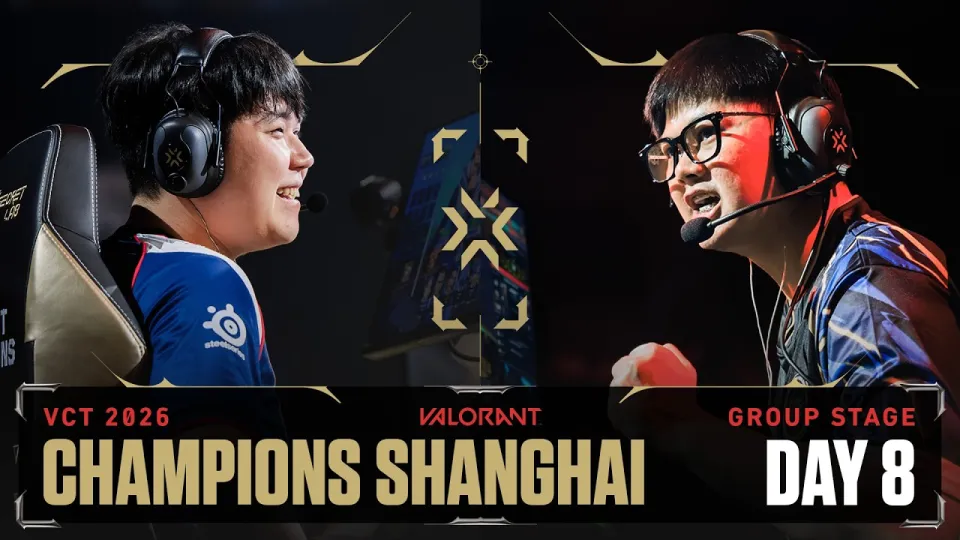
Video: VALORANT Champions Shanghai — Group Stage — Day 8
Want articles like this for your own video to promote it on YouTube and Google? Order them through the Telegram bot @sat_sit_bot. Articles with your video embedded are written and posted by the bot itself — on popular topical sites (no ads). Your first 50 articles are free.
· based on the channel VALORANT Champions Tour
Key takeaways
- Valorant Champions Shanghai runs September 24 to October 18 with 16 teams from Americas, CN, EMEA and Pacific.
- Day 8 of the group stage featured T1 vs JD Gaming, a three-map series that decided the last playoff spots.
- All four Chinese teams were eliminated in the group stage, including JDG after a 6-11 lead slipped away on map one.
- A tech pause interrupted the broadcast during game one, and Munchkin was fielded on a duelist for T1.
- The event is produced by the VALORANT Champions Tour and supported by partners including AWS, Red Bull and Secretlab.
Valorant is Riot Games' 5v5 tactical shooter in which two teams of agents fight over spike plants, economy management and map control across a best-of series. At Champions Shanghai, the group stage's final day decided who advanced to the playoff bracket and who went home, and it ended with T1 eliminating JD Gaming while all four CN representatives dropped out of the tournament. You can follow every official announcement, bracket update and match schedule through the VALORANT Esports account on X, which is the fastest channel for confirmed results.
What Valorant Champions Shanghai actually is
Valorant Champions Shanghai is the season-ending world championship of the VALORANT Champions Tour, and it gathers sixteen teams from four regions: Americas, CN, EMEA and Pacific. The tournament runs from September 24 to October 18, moving from a group stage into a single-elimination playoff bracket where one roster lifts the biggest trophy of the year. The 2026 season had already produced two different Masters champions, which is why the field in Shanghai felt unusually open: established names arrived with something to prove, and a younger generation of challengers arrived without any fear of them.
The format rewards consistency rather than one hot map. Teams must survive the group stage, where series are played on a rotating map pool and every loss narrows the margin for error, then adapt again in the playoffs when opponents can specifically prepare for them. That structure is why Day 8 mattered so much: the last group matches decide not only who qualifies, but also the seeding that determines how brutal a team's playoff path becomes.
Day 8: T1 vs JD Gaming and the fight for the last slots
The headline series of Day 8 was T1 against JD Gaming, a three-map battle that stretched across the broadcast and effectively served as an elimination match. JD Gaming opened strongly and built a 6-11 lead on the first map, a position that would have been one of the most significant results any CN team had produced on the global stage. Instead, the lead slipped away, the map flipped, and the series went the distance before T1 closed it out. The final map was the most lopsided of the three, with JDG unable to recover once T1 took control of the economy and the tempo.
Why all four CN teams were eliminated
All four Chinese representatives exited at the group stage, and the reaction from the global audience was immediate and divided. One camp argued that the region's direct slots were wasted, while another pointed out that playing at home is not the advantage people assume: the pressure, the schedule and the level of preparation from other regions can outweigh crowd support. The more useful read is competitive rather than emotional. CN teams showed they can build leads against top international opposition, as JDG did on map one, but converting those leads requires closing out pistol rounds, managing save rounds and calling the right mid-round adjustments under pressure. Those are exactly the skills that separate a group-stage exit from a deep playoff run, and they are learned through repeated exposure to this level of opposition, not through a format change.
Tech pauses, agent picks and the details viewers noticed
Broadcast details shaped the conversation around Day 8 as much as the scoreline did. A technical pause interrupted the first game, forcing the production team to fill airtime while the match was frozen, and viewers used the downtime to debate everything from background music to server behaviour. Two other talking points stood out:
- Munchkin on a duelist. T1 fielded Munchkin on a duelist role, a pick that surprised viewers who associate him with other agents. Role flexibility is now a standard part of top-tier preparation, because a single unexpected agent assignment can break an opponent's default setup.
- Hit registration questions. Clips circulated of a moment where fewer damage markers appeared than bullets seemed to land, prompting the usual debate about server tick rate and replay accuracy. In practice, spectator overlays and demo playback can under-represent shots, so isolated clips are weak evidence.
- Silencing the Crown. One of the most-liked comments celebrated a Crown being silenced, a reminder of how much crowd emotion attaches to specific utility interactions and clutch moments.
What the group stage results mean for the playoffs
Group stage results in Shanghai set the playoff bracket, and the seeding consequences are concrete. Teams that finish first in their group typically avoid the strongest opponents in the opening round and get more preparation time, while lower seeds walk into immediate elimination matches against rosters that have already found their form. For T1, surviving a three-map series against JDG is valuable beyond the win itself: it means the team has already played a full-length, high-pressure match on stage, which is exactly the kind of experience that pays off in a single-elimination format. For the eliminated teams, the takeaway is a scouting report rather than a verdict. The gap between regions at Champions is measured in rounds and adjustments, not in talent, and the teams that treat the loss as data tend to return stronger.
Common questions from the Day 8 broadcast
Viewers raised several recurring questions during and after the stream, and they are worth answering directly because they reflect how the tournament is actually structured. The first is about home advantage: hosting Champions in Shanghai does not grant CN teams easier opponents or a different map pool, and crowd support cannot compensate for a lost anti-eco round. The second is about format: CN teams hold direct slots as a region, and those slots are earned through the regional circuit, so a poor international result is a competitive outcome rather than an administrative error. The third is about player roles: a duelist assignment is a tactical choice made by the coaching staff, not a permanent position, and it can change from map to map depending on the opponent's tendencies. The fourth is about broadcast interruptions: technical pauses are handled by tournament officials and do not change the match state, though they do break momentum for both teams.
Useful links
- Official VALORANT Esports updates: https://x.com/valorantesports
- Facebook: https://www.facebook.com/ValorantEsports/
- Instagram: https://www.instagram.com/valorantesports/
- TikTok: https://www.tiktok.com/@valorantesports
- Twitch: https://www.twitch.tv/valorant
The bigger picture after Day 8
Day 8 of the Shanghai group stage closed the door on the CN region and opened the playoff bracket for everyone else, and it did so with the kind of messy, three-map series that makes the group stage worth watching. T1 proved it can win when a match turns into a grind, JD Gaming proved it can build leads against elite opposition but not yet hold them, and the audience proved once again that it will argue about utility interactions and hit registration long after the final round ends. The through-line is that Champions rewards adaptation: the teams still alive are the ones that adjusted fastest between maps, not the ones with the loudest home crowd. This breakdown is based on the VALORANT Champions Tour broadcast, and the channel's full VOD of the day is the best way to revisit the series in context. For confirmed schedules, bracket updates and announcements, follow the official account at https://x.com/valorantesports.
Questions & answers
Did any Chinese team make it out of the Valorant Champions Shanghai group stage?
No. All four CN representatives were eliminated during the group stage, including JD Gaming, who lost a three-map series to T1 on Day 8. The result prompted debate about whether the region's direct slots are justified, though the slots themselves are earned through the regional circuit rather than granted arbitrarily.
Why did JD Gaming lose after leading 6-11 on the first map?
JDG built a significant lead but could not close the map, and the series eventually went to a decisive third game where T1 controlled the economy and tempo. Losing that kind of lead usually comes down to dropped anti-eco rounds and mid-round calls rather than a single play, and it is the most painful way to exit a tournament.
Was Munchkin really playing a duelist for T1?
Yes, T1 fielded Munchkin on a duelist role during the series, which surprised viewers who associate him with other agents. Role flexibility is a normal part of top-level preparation, since an unexpected assignment can disrupt an opponent's default setups and force mid-round adjustments.
What caused the technical pause during the Day 8 broadcast?
A technical pause interrupted the first game of the series, and production filled the downtime while officials resolved it. Technical pauses do not change the match state, but they do break momentum for both teams, which is why viewers often treat them as a turning point even when the scoreline says otherwise.
Source: VALORANT Champions Shanghai — Group Stage — Day 8 · Markdown version